
Four Years, One Thesis, and a Lot of Fiducial Markers
Looking back at four years as a Research Engineer at the University of Córdoba: three research ideas, a Ph.D. defended Cum Laude, and the projects that came out of it.
I joined the University of Córdoba in January 2021, first as a collaborating researcher on a Beca Semillero seed grant, building a computer-vision-based mobile app and putting together the research group’s visual identity. By mid-2022 that had turned into a full Research Engineer position, and I left in 2025 with a Ph.D. defended Cum Laude. In between: four years of computer vision, artificial intelligence, image processing, and (if you’ve looked at any other post on this site) an unreasonable number of fiducial markers.
The problem underneath all of it
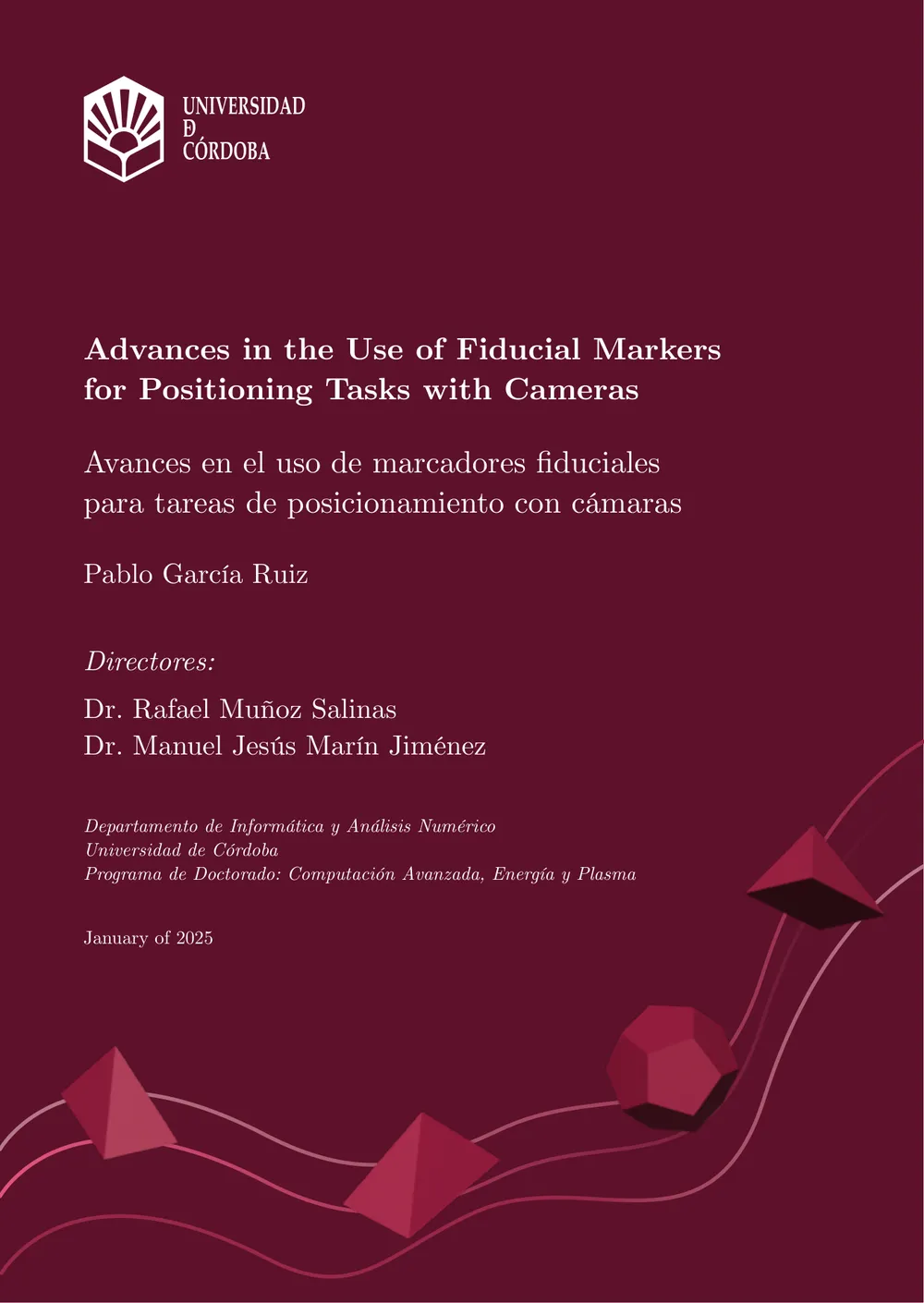
Camera pose estimation (figuring out exactly where a camera is and which way it’s pointing, relative to some reference frame) sounds like a narrow problem until you notice how much depends on it: robotics, augmented reality, 3D reconstruction, autonomous navigation. My thesis, Advances in the Use of Fiducial Markers for Positioning Tasks with Cameras, tackled it from three different angles, each aimed at a limitation the existing fiducial-marker methods hadn’t quite solved.
Three ideas, three projects
Fiducial Objects came first: instead of one flat marker, why not wrap custom-shaped markers around an entire 3D-printed object? It turns out that gives you much more robust pose estimates at close range, where a single marker’s viewing angle gets ugly fast.
Large-Scale Indoor Camera Positioning was the “how do you do this for an entire building” version of the problem: positioning arrays of fixed cameras using reusable markers and graph-based optimization instead of surveying every camera by hand.
Sparse Camera Positioning solved the annoying case in between: cameras that never share a field of view at all. A mobile camera physically carries the marker’s pose information from one fixed camera to the next, chaining relationships across a space that has no direct overlap. It was the last of the three articles I wrote, alongside Markie and the thesis itself.
Somewhere along the way, the fiducial-object idea also turned into Markie, a vision-based input device, and the marker fundamentals became a teaching workshop for people encountering this stuff for the first time. Research has a way of sprawling sideways like that.
Focus areas
Tech stack
Same core toolkit across all three projects, with a couple of additions depending on what a given paper needed:
 C++
C++ OpenCV
 CMake
CMake Qt Creator
 Blender
 Python
 Git
GitWhat four years actually felt like
None of that happened on a straight line. It was advised, argued over, and occasionally rescued by my advisors, Rafael Muñoz-Salinas and Manuel J. Marín-Jiménez, and Cum Laude is as much a reflection of their patience as my own stubbornness. It also happened alongside a fair share of dead ends that never made it into a paper, which is most of what research actually is, if I’m honest.
If any of the three project pages above catch your interest, that’s genuinely why I built them out separately instead of leaving this as one giant thesis PDF nobody has time to read.