
Markie
A Vision-Based Fiducial Object Input Device for Intuitive Interaction
Abstract
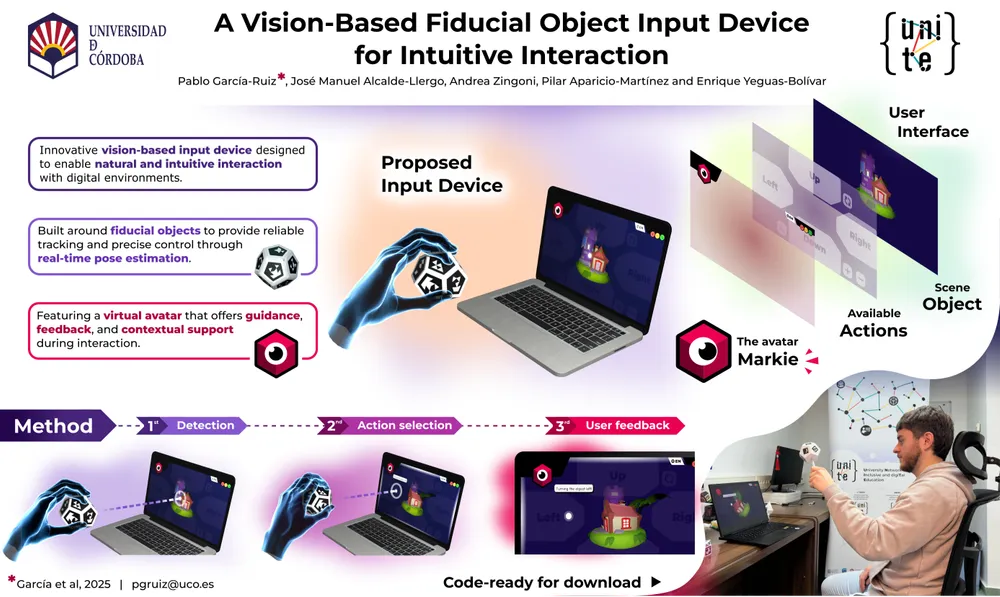
Human-computer interaction plays a crucial role in daily activities, underscoring the importance of developing intuitive, adaptable, and precise interaction mechanisms. In this work, we present a novel vision-based input device that leverages computer vision techniques and fiducial object pose estimation to enable seamless user interaction with digital systems. This input device aims to capture a wide range of user actions and translate them into system commands, offering a natural and adaptable means of interaction.
This work is developed within the framework of the UNITE project, which specifically aims to foster inclusion in education by integrating advanced technological solutions. To achieve this, we designed an interactive experience where users can manipulate and interact with different 3D objects using our developed input device. By providing an accessible and engaging alternative to conventional input methods, this system can reduce the barriers encountered by students with diverse needs.
A preliminary user study conducted with several participants demonstrated high satisfaction, emphasizing the system's fluidity, intuitiveness, and ease of use. These findings suggest that vision-based input devices hold significant potential for enhancing interaction paradigms in both educational and general-purpose computing environments. Furthermore, due to its adaptability and ability to track user interactions in real-time, the proposed system could be seamlessly integrated into new scenarios such as virtual reality or extended reality environments, providing an intuitive and immersive interaction modality for diverse applications.
How It Works
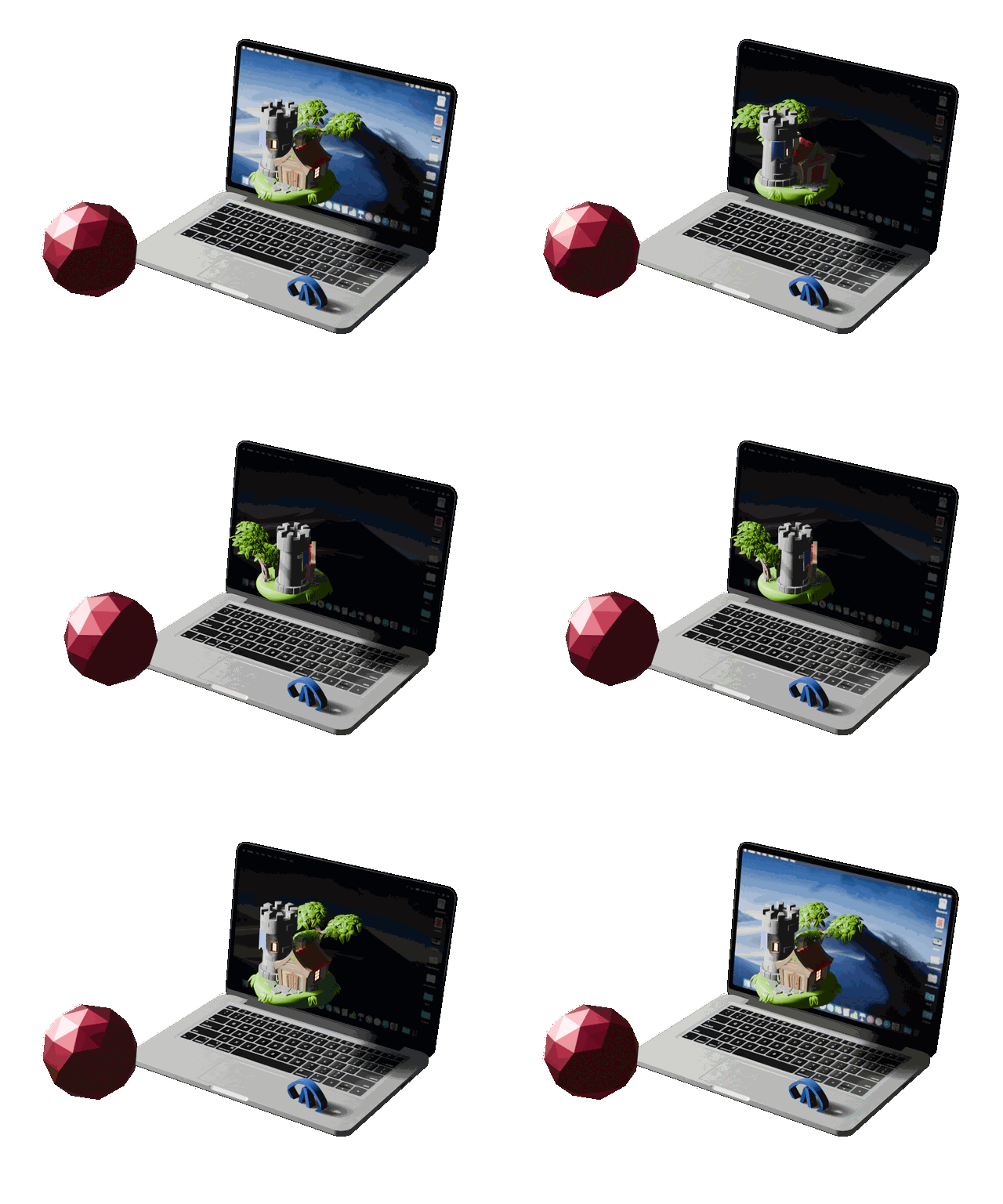
3D-printed fiducial objects are tracked in real time by a standard, uncalibrated webcam, no external sensors, markers on the walls, or camera calibration step required. C++ and OpenCV detect the object's visible faces frame by frame, fuse them into a single 6DoF pose estimate, and reproject it onto an on-screen cursor.
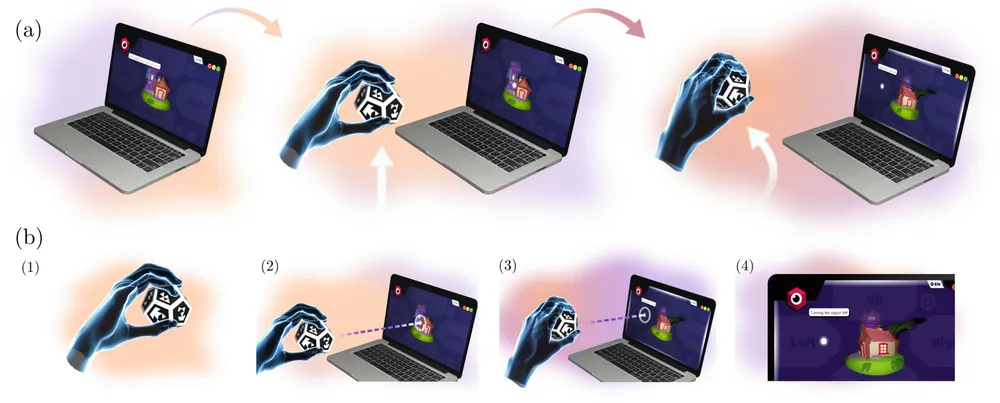
That pose stream is what users actually manipulate: rotating the physical object rotates the 3D model on screen, tilting or moving it pans and scales the view, and swapping between differently shaped objects switches which model is active, all rendered live in a Godot 4 interface, so each physical gesture maps directly onto a system command without any keyboard, mouse, or touch input.
Guiding the experience is Markie, a virtual assistant modeled in Blender who narrates each action in real time and speaks four languages (English, Spanish, Italian, and Turkish) to keep the interaction accessible and easy to follow.
Download
To support the research community and encourage further exploration, the code, tutorials and applications are readily accessible.
View on GitHub C++
C++ OpenCV
 CMake
CMake Godot
Godot Blender
Evaluation
The system was evaluated by 21 participants (ages 21–62), a mix of computer-science experts and non-experts, using an uncalibrated standard laptop camera to reflect realistic, no-special-hardware conditions.
Collaborators


Award
1st Classified: Best Live Demonstration Award
2025 IEEE International Conference on Metrology for Extended Reality, Artificial Intelligence and Neural Engineering
Ancona, Italy · October 22–24, 2025
Citing
If you use this work in your research, please cite:
- García-Ruiz, P., Alcalde-Llergo, J. M., Zingoni, A., Aparicio-Martínez, P., & Yeguas-Bolívar, E. A Vision-Based Fiducial Object Input Device for Intuitive Interaction. University of Córdoba & University of Tuscia, 2025.
- García-Ruiz, P.; Romero-Ramirez, F.J.; Muñoz-Salinas, R.; Marín-Jiménez, M.J.; Medina-Carnicer, R. Fiducial Objects: Custom Design and Evaluation. Sensors 2023, 23, 9649.

@inproceedings{10.1007/978-3-031-97763-3_22,
  author = {Garc\'{\i}a-Ru\'{\i}z, Pablo and Alcalde-Llergo, Jos\'{e} Manuel and Zingoni, Andrea and Aparicio-Mart\'{\i}nez, Pilar and Yeguas-Bol\'{\i}var, Enrique},
  title = {A Vision-Based Fiducial Object Input Device for Intuitive Interaction},
  year = {2025},
  isbn = {978-3-031-97762-6},
  publisher = {Springer-Verlag},
  address = {Berlin, Heidelberg},
  url = {https://doi.org/10.1007/978-3-031-97763-3_22},
  doi = {10.1007/978-3-031-97763-3_22},
  booktitle = {Extended Reality: International Conference, XR Salento 2025, Otranto, Italy, June 17–20, 2025, Proceedings, Part I},
  pages = {289–297},
  numpages = {9},
  keywords = {Tangible interaction, User interface, Fiducial object, Fiducial marker, Input device},
  location = {Otranto, Italy}
}
Paper
The full paper is openly available (CC BY 4.0) and can be read or downloaded on Zenodo.
View on ZenodoLicense
This software is licensed under MIT License.