
Fiducial Objects
Custom Design and Evaluation

Abstract
Camera pose estimation is vital in fields like robotics, medical imaging, and augmented reality, and fiducial markers (square patterns such as ArUco and AprilTag) are widely preferred for their efficiency. However, as single flat markers, their accuracy and usable viewing angle are inherently limited. Attaching several markers to a 3D object (a fiducial object) improves visibility from multiple viewpoints, but existing approaches mainly wrap standard square markers around non-square object faces, wasting usable surface area.
This work introduces a method for creating fiducial objects with custom-shaped markers that optimize coverage of each face of the 3D solid, improving both space utilization and marker detectability at greater distances. Alongside the design method, we present a technique for precisely estimating a fiducial object's configuration from multiviewpoint images, and release the code, tutorials, and application needed to build and calibrate these objects.
An empirical analysis across noise levels, blur, and scale variations shows that these customized markers significantly outperform traditional square markers for pose estimation, marking a meaningful step forward for fiducial-marker-based positioning.
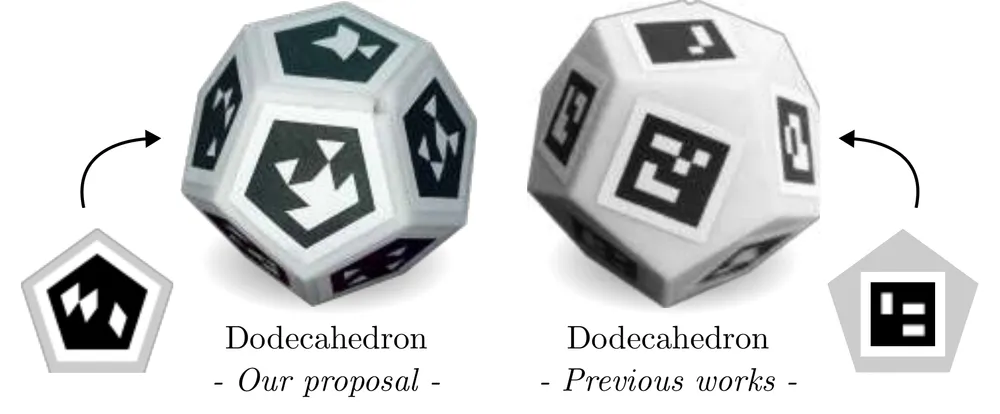
How It Works
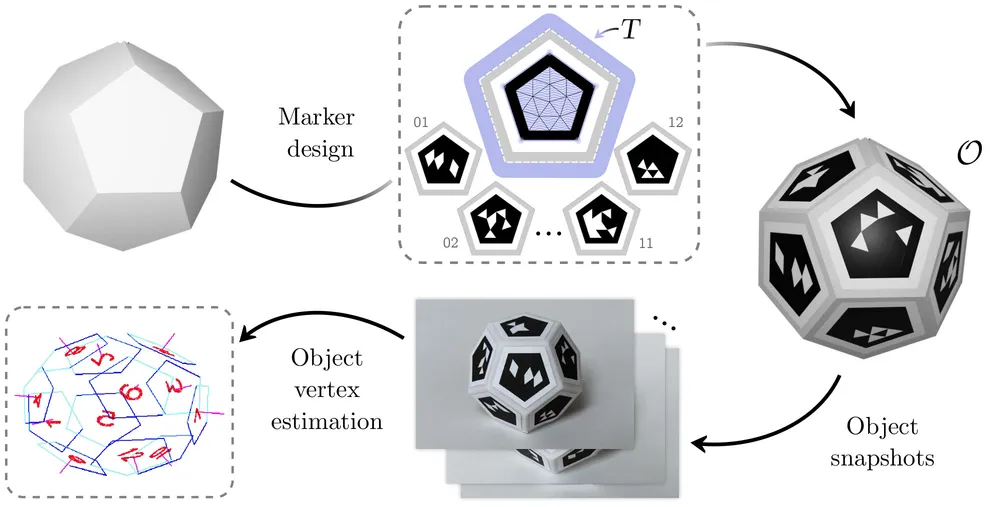
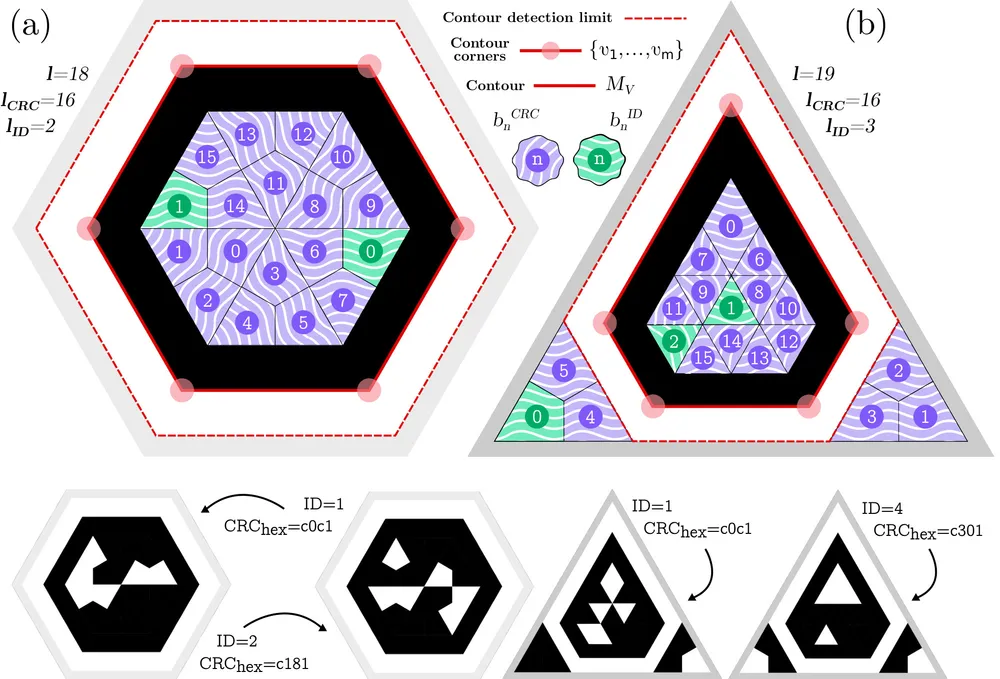
Starting from a target 3D solid (a cube, dodecahedron, or any of several other geometries) each face is treated as a separate canvas: instead of forcing a square ArUco pattern onto it and wasting the unused corners, a custom marker shape is generated that fills the face edge to edge, maximizing the amount of detectable pattern visible from a distance or at a steep angle.
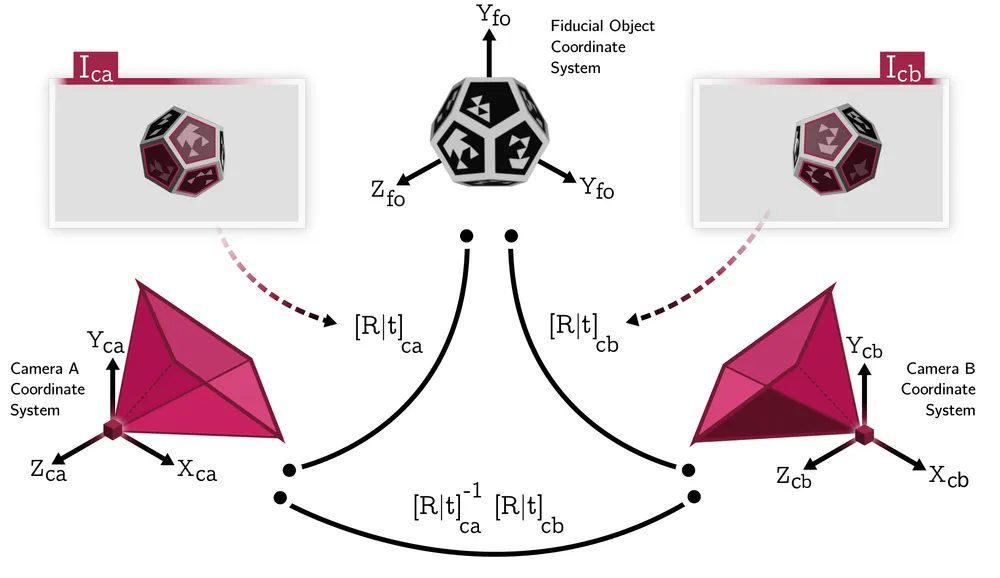
Those custom markers are rendered as textures and applied to the physical, 3D-printed object. Because no two fiducial objects are manufactured with perfect geometric precision, a calibration step follows: a set of multiviewpoint snapshots of the printed object is used to estimate its exact vertex configuration, correcting for small deviations from the ideal digital model. The pose-estimation pipeline then combines detections from every visible face of that calibrated configuration into a single, more accurate and more robust 6DoF pose at run time.

Download
The code, tutorials, and application to build and calibrate fiducial objects are openly available, along with the dataset generated for the paper.
 C++
C++ OpenCV
 CMake
CMakeEvaluation
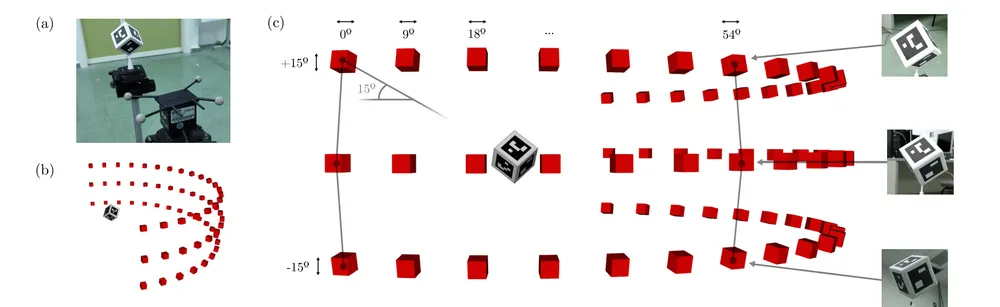
Custom-shaped markers were benchmarked against traditional square markers across varying noise levels, blur, and scale, using the experimental camera-positioning setup below.

Results
2×
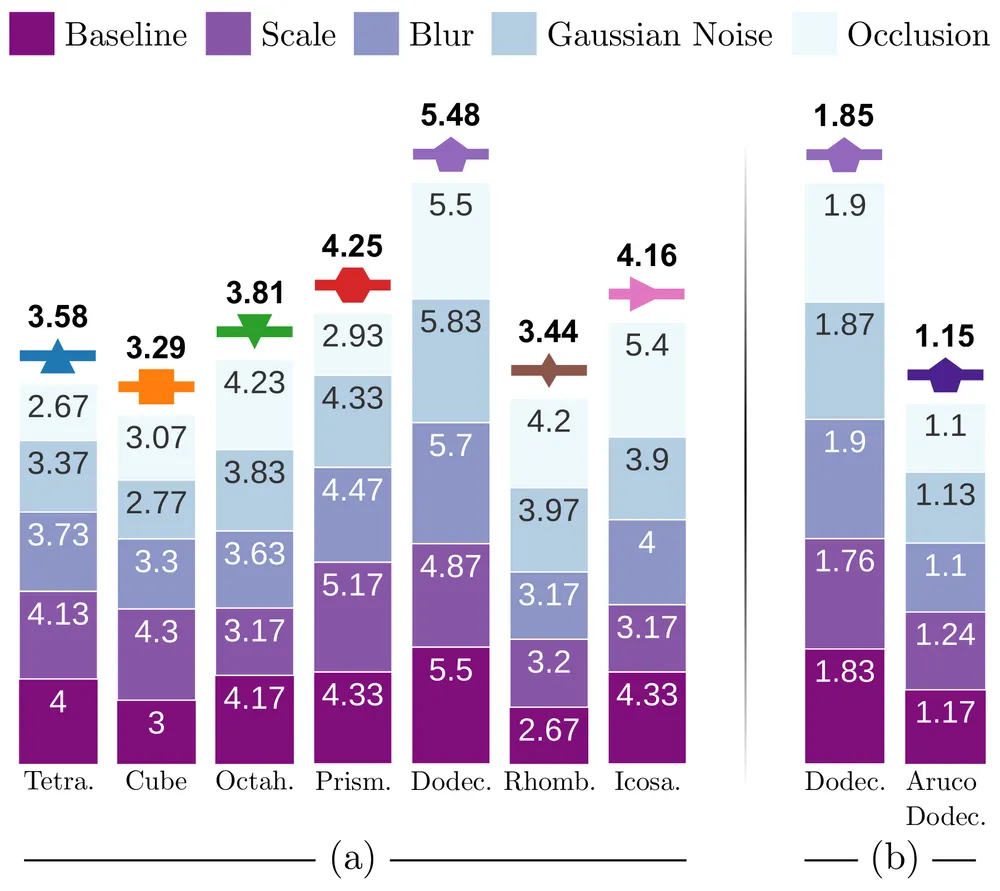
the pose-estimation precision of standard square (ArUco) markers, in most test conditions
1.41–2.20 mm
translation error across tested objects, baseline conditions
100%
detection rate in ideal conditions
7
solid geometries tested; the dodecahedron ranked most robust overall
The advantage widens under harsh conditions: at heavy blur, the dodecahedron kept a 100% detection rate versus 73.02% for the icosahedron; under heavy Gaussian noise it held 69.84% versus 38.10% for the tetrahedron.
Collaborators


Award
Best Communication Award
XII Congreso Científico de Personal Investigador en Formación de la Universidad de Córdoba
Córdoba, Spain · June 2024
In the Media
Citing
If you use this work in your research, please cite:

@article{garcia-ruiz2023fiducial,
  author  = {Garc\'{\i}a-Ruiz, Pablo and Romero-Ramirez, Francisco J. and Mu\~{n}oz-Salinas, Rafael and Mar\'{\i}n-Jim\'{e}nez, Manuel J. and Medina-Carnicer, Rafael},
  title   = {Fiducial Objects: Custom Design and Evaluation},
  journal = {Sensors},
  volume  = {23},
  year    = {2023},
  number  = {24},
  articleno = {9649},
  doi     = {10.3390/s23249649},
  url     = {https://www.mdpi.com/1424-8220/23/24/9649}
}
Paper
The full paper is openly available (open access) in Sensors, hosted on PubMed Central.
View on PubMed CentralLicense
This software is licensed under MIT License.