
Sparse Camera Positioning
Sparse Indoor Camera Positioning with Fiducial Markers
Abstract
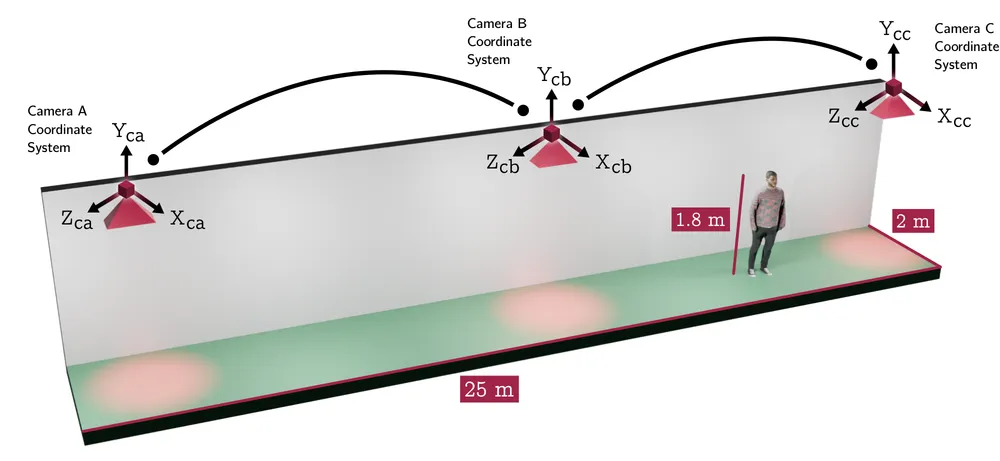
Accurately estimating the pose of large arrays of fixed indoor cameras is a long-standing challenge in computer vision, since most existing methods depend on cameras sharing overlapping fields of view. This work presents a methodology that positions fixed cameras with and without overlapping views in complex indoor scenarios.
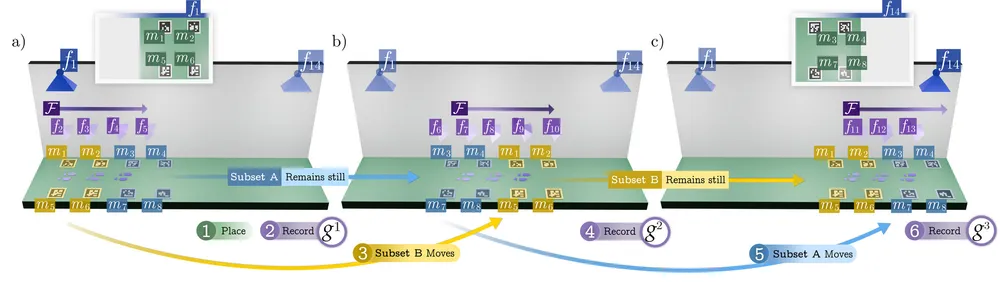
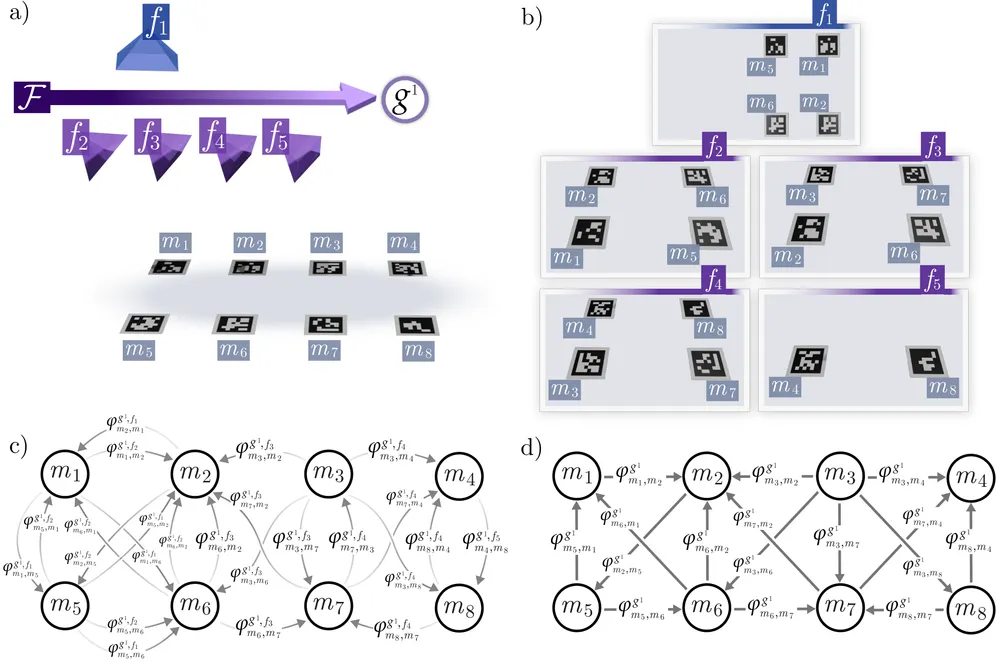
A subset of fiducial markers, printed on regular paper, is strategically placed and progressively relocated through the space. An additional mobile camera records these markers as it moves, gradually connecting every fixed camera in the network, even when consecutive cameras never see each other directly. A final optimization stage minimizes the reprojection error of all observed markers while enforcing real-world physical constraints, such as camera and marker coplanarity.
The method was validated on novel datasets built specifically for this work, spanning corridors, floors, and an entire multi-story building, and it outperforms prior sparse-positioning techniques, establishing a new state of the art for camera networks that cannot rely on overlapping views.
How It Works
A small set of fiducial markers, printed on regular paper, is placed within view of one fixed camera and then physically relocated, one hop at a time, into view of the next. A moving camera follows this trail and continuously records the markers as they travel, capturing the local geometric relationship between each pair of fixed cameras along the way, even when those two cameras never actually see one another.
Chaining every one of these pairwise relationships across the whole space builds a single connected graph linking all fixed cameras. A final bundle-adjustment-style optimization stage then refines that graph jointly, minimizing the reprojection error of every observed marker while enforcing real-world physical constraints such as camera and marker coplanarity, to recover every camera's pose in one consistent coordinate frame.
Evaluation
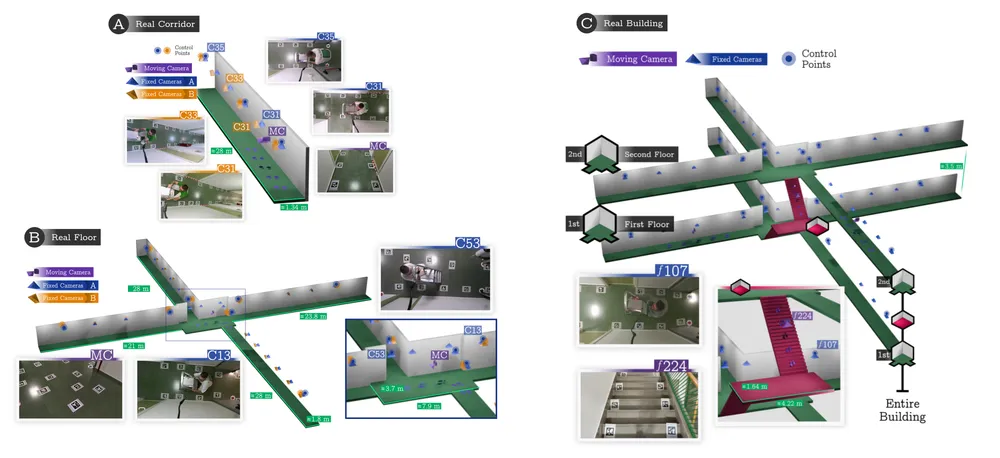
The method was validated on novel real-world datasets built specifically for this work, spanning a corridor, a full floor, and an entire multi-story building, with camera networks that deliberately lack overlapping fields of view, the scenario prior sparse-positioning techniques struggle with most.
Results
| Dataset | Fixed cameras | Marker groups | Translation error |
|---|---|---|---|
| Corridor | 6 | 2 (50 markers) | ≈13–16 cm (≈5–6% of path) |
| Complete floor | 22 | 10 (50 markers) | ≈24–27 cm |
| Entire building (2 floors) | 42 | 23 (50 markers) | ≈42 cm |
None of the camera pairs above share overlapping views, the scenario prior methods can't position at all.
Applied back to the same dense, overlapping-view floor dataset from the Indoor Camera Positioning paper, these refinements cut the previously reported 14.82 / 15.72 cm error down to 5.22 / 4.88 cm. Automatic marker-linkage detection reached up to 100% true positives with zero false positives, and the reference (non-optimized) implementation processed each dataset in about 3h 32m on average.
Code & Data
Code and datasets used to validate the method are publicly available.
 C++
C++ OpenCV
 CMake
CMake Qt Creator
Collaborators


Citing
If you use this work in your research, please cite:

@article{garcia-ruiz2025sparse,
  author  = {Garc\'{\i}a-Ruiz, Pablo and Romero-Ramirez, Francisco J. and Mu\~{n}oz-Salinas, Rafael and Mar\'{\i}n-Jim\'{e}nez, Manuel J. and Medina-Carnicer, Rafael},
  title   = {Sparse Indoor Camera Positioning with Fiducial Markers},
  journal = {Applied Sciences},
  volume  = {15},
  year    = {2025},
  number  = {4},
  articleno = {1855},
  doi     = {10.3390/app15041855},
  url     = {https://www.mdpi.com/2076-3417/15/4/1855},
  issn    = {2076-3417}
}
Paper
The full paper is openly available (CC BY 4.0) in Applied Sciences.
View on MDPILicense
Code and datasets are shared under the MIT License, consistent with the related Indoor Camera Positioning project.